Showing posts with label VFH Seal of Approval. Show all posts

Wednesday, September 1, 2010

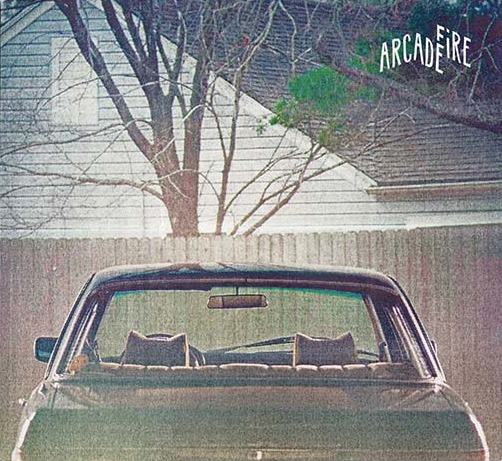
Arcade Fire - The Suburbs

Continuing on my "Week of Catching Up" here's the first of two album reviews for the week, Arcade Fire's third and latest album, The Suburbs, which released earlier this month without me realizing until a few days later. Regardless, the albums here, it's been here the whole month, so how's it holding up after all this time? Read on to find out, you may actually like this review!

In short, really well actually. With the first two Arcade Fire albums (I came into the band's music kind of late) I really liked them at first, and would listen to both together a lot, but after a while of listening to other things, I found them hard to get back into. When I got The Suburbs, I was really into it and already charted up play counts that surpass both of the band's first two albums combined, and I think that says a lot. Since then, however, I've spent a lot of this month listening to Anamanaguchi and Talking Heads, and didn't get back into this album until I decided to finally review it today, and it's still holding up just fine.

What's more interesting about the play-count feat though, is that this album is an hour long, as opposed to the just over 45 minute lengths of both 2004's Funeral and 2007's Neon Bible; that means I've done more listening of this hour-long album in the past month than I have of the previous 90 minutes in the past year. Instead of my usual album rundown, I'm just going to post a few highlights in track order, so, some tracks may be skipped.

The titular track and album opener, "The Suburbs," starts out this concept album perfectly, giving you a sense of a dramatic suburban tour, really setting the mood for the rest of the album, and is now one of my favorite tracks from the band. "Ready To Start" continues with this vibe, while "Modern Man" feels like something of Funeral. Passing on a few tracks, I found "City With No Children" to sound like a Bruce Springsteen song, except you know, appealing... And then you have a rock heavy track like "Month of May" which sounds like something the White Stripes would come up with if they had more than just Jack and Meg, not that that's bad or anything.

Unlike a lot of albums I've listened to, I found that The Suburbs didn't die out near the end of the album. If anything, it dies down mid-way after "Month of May" and then quickly brings itself together in the wonderful "We Used To Wait" after two slower tracks. But my favorite track comes after "Sprawl I," you guessed it, "Sprawl II," which sounds like a mix of "Haiti" off of Funeral and "Heart of Glass" by Blondie; actually, it sounds a lot like Blondie, and for whatever reason hearing new 80's style synth-pop sounds really appealing in the context of this album, and for that I love it, and it's the longest track too, which is a plus when it sounds this good.

What I love about this album, is that it really works as an album. What I find with a lot of records nowadays is that there's never a universal thing that holds them together; you have a few great tracks, and then some boring throwaway material. But with The Suburbs, I find that I really prefer listening to it as a whole on loop, as opposed to being shuffled with the rest of the Arcade Fire tracks. And by having the track rundown that fades in the middle, as opposed to starting strong and dying out at the end, makes it that much more appealing to listen to as a whole because you're not just going through waiting for the good parts, as the album supports itself from beginning to end. If you've never listened to Arcade Fire before, nows a great time to start.

Overall Score: 9.7/10

Now, here's the thing, I agree that like most things, everyone has there own tastes and not one single thing can be considered perfect. And when it comes to music there's definitely a lot more debate in that department. But, in this one instance, I'm going finally award the first VFH Seal of Approval to an album because it's just that good, and just that much better from the band's previous albums. (And this is almost still the month the album was released in...) Now, what happens when they release another album that's "better"? You ask? Well, judging by the three year gaps between each album, I guess I'll have to worry about that then, and who knows if we'll still be online by that time. For now, I'll enjoy this wonderful record.

Note: The album actually has eight different cover art variations, the one pictured is just the one I happen to have.

Monday, May 24, 2010

This Week in Lost - 5/23/10

It's here, it's The End.

Series Finale: Episodes 17/18 - "The End"

Zach says: It's over. Like usual, I could talk about everything that happened in this episode, but I don't feel it's necessary. And, I won't even give too many details as to the ending, because you've either already seen it, or you don't want me spoiling it for you. But, I may talk about some details/spoilers a bit into my discussion.

Personally, I think this finale was by far one of the best episodes of the series. It didn't answer too many of those lingering questions about the island and what it's all about, which, while thinking back about the finale and the series as a whole, can be a little disappointing, but looking at it in a vacuum, just the finale, it was amazing on so many levels.

Every character in the alternate universe "wakes up" at some point this episode, and each and every one of these moments is truly touching. We see flash backs from previous seasons, as well as the characters seeing each other in the present time and it clicks, and the emotion is so strong you can't help but feel something, as you've invested in these peoples' stories and feelings. You were with them through six years and can't help but feel connected to them and understand all that they have gone through. It's great seeing them remember and embrace one another. It was also great to see long neglected characters like Rose and Bernard, as well as Juliet. They may not have played the biggest roles, but it was definitely nice to see them again.

There is plenty to discuss and debate and be upset about. It's hard to fully understand what the alternate reality REALLY is and what its true relevance is. The same is true with the island itself, and what events happen after that of the finale? We will most definitely never get answers to these questions, but I guess they aren't necessary.

You may go into the finale with the desire to get all these answers, about WHAT the island is and WHY everyone is there, but once you get into the episode, you begin to really just care about the characters and getting their own resolution and seeing everyone's story wrap up, and I think this is done very well. I'm going to leave it at that.
Zach's Score: 10/10

JDW says: "The End" was the first (and last) episode of Lost I ever watched with a group of people; hell, I even took off of work just to spend five and a half hours of my life in front of the television. Point being, this was a show that a lot of people have invested so much time in, both with and away from the TV set, and in it's most important moment, it was something that needed multiple reactions, and I think we were all floored.

Years of speculation, theory, and just pure time dedicated to this show, and it was embraced beautifully in a two and a half hour epic. Sure, there's already plenty of people that hated this episode because it didn't answer every single question. But, to be honest, the more I think about some of those trivial things, the more I could care less, because "The End" showed us what was really important: life, and the people you share it with. It was great to see all these familiar faces together, happy at last; sure some were absent, but for the most part their absence was explained.

But seriously, do really need to know how the black smoke monster works? Or how exactly the island can disappear? Or why exactly did Jacob need to bring people to the island? No, not really. And I think if everything was explain, peole would still be pissed off because it get's into "midi-chlorian" territory, and takes away all the mystery that made the show so interesting a discussable to begin with. If the show just always blatantly explained how everything works, we would have never made it passed the first season. That's why FlashForward is so awful.

What the "The End" really was, was a beautifully crafted piece of fan-service for the people that weren't watching with a checklist of unanswered questions. Not only from the actors performances, but from the directing by Jack Bender, and Michael Giacchino's moving score, all the pieces came together really really beautifully, and if you didn't feel anything after spending so much time with these characters, then really, you're soulless. You may not have gotten all the answers you wanted, but I find it ridiculous that people have not gotten some sort of closure or gratification from "The End," because I know I found this ending to be oh so fitting for a show I've invested so much time in, and everyone else I watched it with seemed to be in agreement.
JDW's Score: 10/10

Overall Score: 10/10

I don't think it would be fair to have a review with two 10/10 scores and not give it the VFH Seal of Approval, that just wouldn't make sense. And for an episode of a show that will most definitely be part of every television discussion for the next century, it would be impossible for us to not give this episode some much deserved, extra credit. If we could give this two awards we would. And to those who didn't dedicate six years of thei life to this show, do yourself a favor and get Seasons 1 through 6 when they release in a set on August 24th, you will not be disappointed, especially once you've reached this wonderful, beautiful, and just plain fantastic episode.

Missed the episode? (What is wrong with you?) Watch all 2.5 hours of it on Hulu.

Saturday, April 17, 2010

This Week in Doctor Who - 4/17/10

After that awesome screening and Q&A, it's time to finally review the latest Doctor Who episode! And remember, this is coming after seeing it not only in the theater, but television as well:

Sure, we're getting it two weeks later than the UK; sucks, but, two weeks is better than two months, a year, and so on. Point is, the new series of Doctor Who is here and whether you want to call it Series 5, Series One, Season 31, the 2010 Series, whatever, you better damn well be excited because this episode was brilliant!

Episode 1 - "The Eleventh Hour"

Where shall we begin? The episode literally takes place right after "The End of Time," with our newly regenerated Doctor (Matt Smith) falling recklessly back to Earth in his damaged TARDIS, unable to fully recover from the regeneration. But before landing, I should mention, we're treated to the brand new series opening and theme, which took some getting used to, but the more I think about it, the more I liked it. And after all that, the TARDIS lands, at a house where a young girl lives, and she's been praying for someone to come fix a mysterious crack in her wall. But the Doctor can't fix it at this time, because much like himself, the TARDIS needs to recover as well, and he needs to leave before the problem can be remedied.

When he returns, however, he finds out he's been away much longer than he realized, 12 years, and that little girl is now a full grown woman, Amy Pond (Karen Gillan), who is currently working as a kissogram (look it up). Upset by the Doctor ditching her for so, she's very reluctant to start trusting this mystery man that's come back into her life, even if it's in the face of global destruction. There's more obviously, much more, considering this is a 65 minute episode as opposed to the usual forty or so minutes, but despite this being two weeks after the spoiler zone, I still don't need to transcribe the whole episode.

But, I will talk about the new Doctor; and I'll tell you this much, if you had any doubts in Matt Smith taking over the role of the Doctor after David Tennant's great run, lose them now, because he's FANTASTIC. He's a slightly like Tennant, but a bit more goofy, I haven't seen too much of classic Who, so it's hard to place specifics on those Doctors but, in his Eleventh incarnation, he's still very much The Doctor. There's a great scene near the end of the episode, where the Atraxi (the supporting "enemies" of this episode) scans through data of Earth, and it goes through a bunch of clips from old and new Doctor Who, even showing the previous ten Doctors, and then Smith emerges through it all, and it's so so brilliant.

Amy is great as well; in her older self she doesn't immediately fall and trust the Doctor like Rose or Martha, she actually has some spunk and personality which was nice, but it seems like she still has a lot of character development left (the cliffhanger ending says a lot). And then there's the writing, there's such a huge difference between Steven Moffat's and Russell T. Davies' writing. The episode has some really great storytelling, and there's a big focus on the show being more of a time-traveling fairy tale more so than a science fiction tale. Even the filming style is different than the previous series, it's much more dramatic and cinematic, and it works so damn well. The CGI still isn't the greatest, but it's improved over what we've seen before. Oh, and the soundtrack is fantastic, just in case I forget to praise... y'know, everything.

"The Eleventh Hour" is a great start to this new Smith/Moffat era of Doctor Who. I mean, it's definitely my new favorite Doctor Who episode, since "Blink" (which was of course, also written by Steven Moffat), and I'm already loving Matt Smith as the Doctor. Sure the story may not be the most inventive, and there are some holes, but if this episode is any hint at what's to expect for the rest of this season, count me in, and count yourself in as well.

Overall Score: 9.5/10

I know, I feel like these Seals of Approval are just being handed out left and right recently, but this episode is just so damn good not to give it a high mark. It may seem a bit unfair, I mean, it is just the first episode in long line of more to come, for all I know they could be even better. Also, being the first in a brand new series, which unlike the last 3 series, makes it almost as accessible to new viewers as it is to long time fans. It's not open-ended like the Series 1 premiere, "Rose," as this is directly after "The End of Time," but if you've missed Doctor Who up until now, now's the perfect time to get into this wonderful series.

Thursday, April 1, 2010

This Week in Fringe - 4/1/10

Yes!!! Fringe is back, so of course, This Week in Fringe is back as well. Spoilers below.

Episode 15 - "Peter"

After a two month break, it's great to see Fringe back on TV again, because despite Lost being good this season, I'm already starting to hate FlashForward again, so at least I still have Fringe around to be my good American science fiction show, when it's not going off topic... which is why this week's episode was so great, it stayed on topic!

What do I mean? I mean that for the first time... maybe ever, the show not only answered the cliffhanger from the last episode (when Olivia sees a shimmer around Peter, finally concretely revealing that he is indeed the Peter from the alternate universe), but it didn't have some other sort of semi-related "case/creature of the week". This episode was all about exactly what happened with Peter and Walter and how the alternate Peter came to be. And it was perfect.

95% of the episode takes place in the past, late eighties/early nineties, no specific date is given, but they point out that the first George Bush is President... though they also show that Back to the Future is in theaters (and starring Eric Stoltz, who in real life was in the role, and then recast) and that actually released in 1985, so it's a bit confusing. Regardless, the show even opens with a fantastic eighties version of the Fringe opening and theme, and all the flashback scenes are shot with that soap-opera'y glow effect. Also fascinating is the make-up job done on John Noble, because it really did make Walter seem twenty years younger. I was only upset to not see a young William Bell (Leonard Nimoy), because less face it, when has Nimoy not looked old? A missed chance.

I really loved seeing young, sane Walter, it was like watching a completely different man on screen, yet he was still oddly familiar. The tragic tale of him and his wife (who you finally get to see) losing their son is quite touching, and their struggle to get him back is even more so. Sure, a bulk of the episode is just visual representation of things we already knew or have been told, so there weren't too many revelations, but just seeing it was such a shift in tone and design for the show, and it was pretty fantastic. It's just kind of annoying to know that the rest of the season will probably go back to being same old Fringe, but just this once, it got to be something special.

Overall Score: 9.5/10

I don't think I need to explain myself this time around, as that review really says it all. After being frequently disappointed by the rest of Fringe's second season, and a two month gap, "Peter" was the episode that every Fringe follower wanted to see, and then some. If you haven't watch the show yet, it's still not too late, skip through all the fluff episodes, watch the main story ones, and then watch this in amazement. More of this please, thanks Fringe.

Missed the episode? Watch it on Hulu

Saturday, March 20, 2010

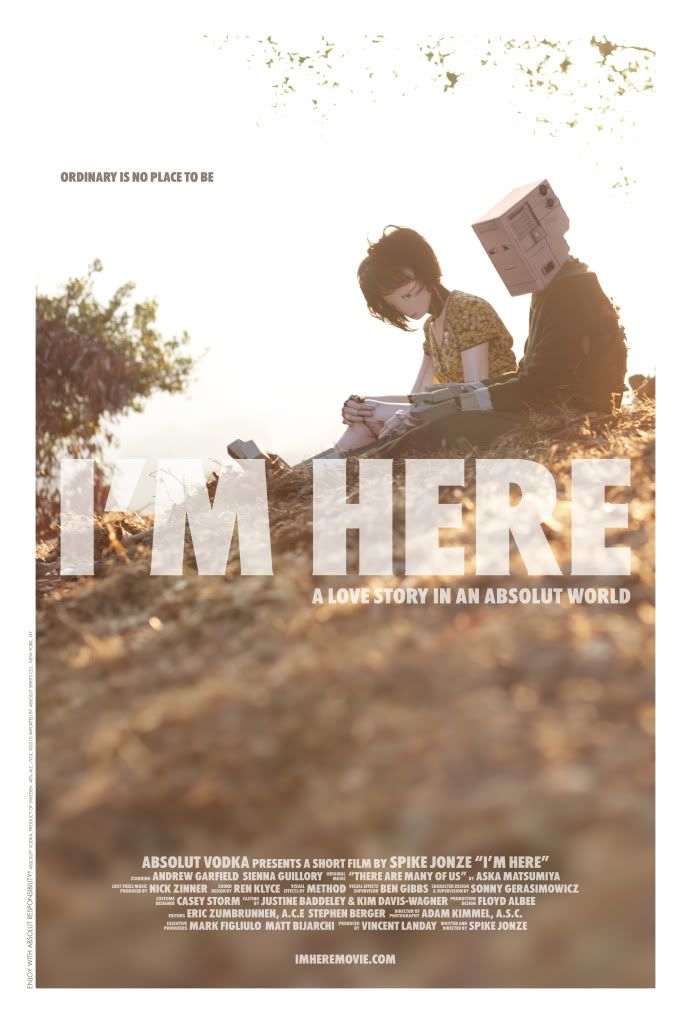
I'm Here review

This one's a bit of a surprise, as it's not a theatrically released film, nor is it a disc release film. It's exclusive to the web, and to 5,000 viewers each day, but it's beautiful. But, what is it?

I'm Here is a thirty-minute short film from director Spike Jonze (Where The Wild Things Are, Being John Malkovich), released and presented by Absolut Vodka, but despite that, the product never appears in the film, nor is it mentioned, so really you can take the film for what it is and not look at it as a commercial.

You can watch the film right now (hopefully) at http://www.imheremovie.com/ I say hopefully, because the way the film works is that it will only be screened for 5,000 people per day, and only at certain times. For instance when I tried earlier today there was a two hour wait, so I didn't bother. But when I tried later, it was just a 30 minute wait, so I just kept reloading the page until the time was up. And thankfully, once you get in, you'll never be kicked out until you close the page or reload, so you're able to have multiple viewings.


The film is a love story about two robots, Sheldon and Francesca, who live in Los Angeles. The robotic beings aren't very well accepted in society, so when the two first lock eyes, it's love at first sight. As I said earlier, the film is only thirty minutes, so it'd be unfair for me to give it all away. But I found it to be like a hipster version of WALL-E, but filmed in the same style and tone as Where The Wild Things Are. And considering I loved WALL-E, and found the filming style of Wild Things to be the only part I really liked, I'm Here really turns out to be quite the nice piece of modern cinema, both visually and emotionally.

What I really loved about the film, is that despite the fact that it stars robots, which are actually just the actors in costume with computer generated facial expressions (much like Wild Things' fur suits), it never once came across as unbelievable, because visually it was just accepted as real. It's so rare these days to see something science fiction like this, without tons of back-story and explanation given as to how they exist. Perhaps it was due to the 30-minute time frame, but regardless it wouldn't have been necessary.

I'm Here is a beautiful short film, and I just hope it gets a disc/digital release eventually, because I'd love to see to see it get more exposure than just here on my laptop in a web-browser. Do yourself a favor, and watch this movie.

Overall Score: 9.5/10

As a just because. Because I thank Absolut for giving this film a home for almost everyone to enjoy, free of charge. Because I'm glad Spike Jonze made a film that wasn't a big budget pseudo-adaptation of a beloved children's book, after having already done so. And because he made a science fiction film that deals with very human emotions, despite it being about robots. Loved it, because sometimes you just have to reward people for doing something different and getting it right.

Sunday, January 31, 2010

Uncharted 2: Among Thieves Review

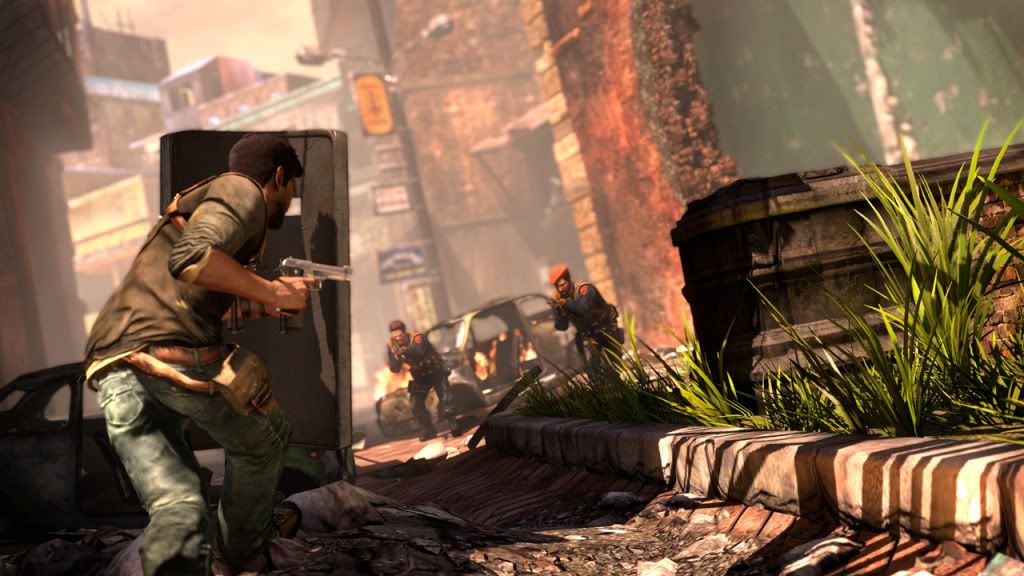
Call this delayed, but at least it will be worth it. We're going to start off a new type of review today with a very special game, Naughty Dog's Uncharted 2: Among Thieves, sequel to 2007's Uncharted: Drake's Fortune, and considered by many publications to be 2009's Game of the Year. But what make's this review different, you ask? This is VFH's first ever two-person game review!

Much like certain This Week In features, two-person game reviews will be divided into categories, with each reviewer giving their thoughts. To differentiate, my (JDW's) text will be default black, while Zach's parts will be in red. Let's get to it!

Story
Uncharted 2 brings us back to the story of adventurer and smart talker, Nathan Drake, who has just woken up, bleeding, in a train hanging off of a cliff. What a way to start the game! You'll soon find out why, meeting both new and familiar faces along the way. Personally, I think the story of Uncharted 2 was really nice, it seemed a little more thought out than the first game, and thanks to the cinematic experience, was aided by the use of flashbacks and proper chapter cuts, making it feel more like a lengthy TV series or a movie, rather than just an adventure game.

Among Thieves delivers a similar story to its predecessor. It is filled with exploration, discovery, and twists. You start out with Drake and a couple of compatriots pulling a routine heist, but it soon evolves into something much more; an epic quest. The story flows fairly well from one environment to the next, where you may meet some familiar faces. However, I felt that it started to drag on towards the end, where the same thing kept happening again and again. You explore a new area/puzzle, and then the enemy finds you and you have to fight and run away. It was starting to get dull.

Gameplay
Among Thieves plays just like Drake's Fortune, only better. But how do you make it better? Well for one, Sixaxis controls are optional now; so if you weren't a fan of angling the controller to toss grenades, turn it off (I was used to it, so I left it on), and the parts where you had to cross logs or other beams no longer makes you balance Drake out, which cuts the frustration level. Also great is that a lot of the game plays out in a cinematic fashion, like when you're being gunned down by a helicopter while trying to navigate through a train, not getting through certain parts on time will result in you blowing up. It's a not a time limit, per say, but I felt it made the game much more immersive.

What I also appreciated was the improved Medals system. While the first game had Medals (which eventually were patched to earn Trophies), the ones this time around are a bit better. Not only do some of them earn Trophies, but there's some non-Trophy ones as well that make you play in a way you wouldn't have thought of. Granted, it'd be nice to get Trophies for all the goals, but, whatever, at least I can still earn unlockables from it all.

If you played the first Uncharted, then you will be ready for Among Thieves, as the gameplay is nearly identical. It is a third-person cover-shooter with a little puzzle solving on the side. There are plenty of moments for stealth, as it is better to attempt to take down a room of soldiers without anyone noticing, rather than going in shooting, however, when one enemy does happen to see you, the game isn’t over. You simply need to stay behind cover and take out the remaining opponents. They will lob grenades at you from time to time to get you to move around, but it isn’t too difficult. However, if you plan to run around without taking cover into a swarm of guards, you’ll be restarting very often.

Aside from the shooting, you’ll be doing a ton of climbing around buildings and solving relatively simple puzzles in order to continue on your path. Most climbable objects are highlighted in an obvious yellow or other bright color, but others aren’t. After playing the game for an hour, you’ll start to pick up on what is climbable and what is not, although there will be times when you run around aimlessly trying to figure out where you’re supposed to go or how you’re supposed to get there. There is a hint system, although it isn’t the most helpful.


Multiplayer
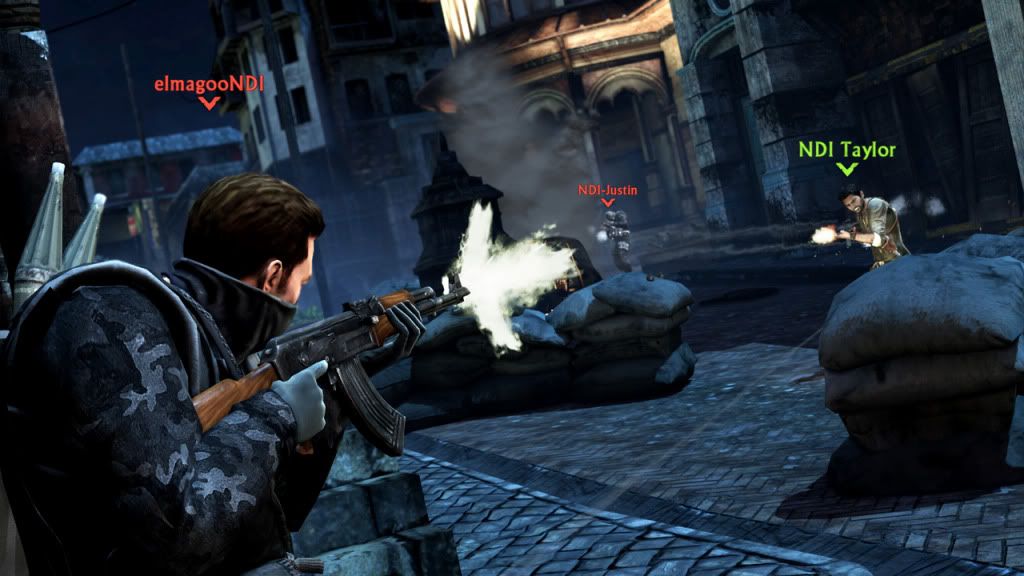
Most of the time I spent in Uncharted 2's online multiplayer was actually during the beta test, but I can say from what I've experienced now that it's very much improved. You have your stan deathmatch, team deathmatch, king of the hill, and a few other modes that I'd rather not deal with explaining; there's even a machinima mode for creating custom movies! But the most fun I've had online is the co-op, which allows up to three players to cooperatively play through adjusted parts of the story mode. Adjusted as in, the map's basically the same, but the scenarios are adjusted to fit 2-3 players. Only issue is that a good percentage of PSN gamers lack a headset (I'm guilty of this) and communication may be an issue.

I have only played team deathmatch so far, but it plays just like the single player. You have a gun, with others scattered around the map, and you try to kill people. It takes a minute to learn each map, but finding out where the good guns are placed takes longer. Playing against more experienced players will obviously put you at a disadvantage, as they will quickly pick up the shotguns and RPGs and leave you empty handed, waiting to be pulverized. You also have two perk slots, where you can purchase and then equip a perk. You unlock more as you rank up and they do an assortment of different things, like giving you more accuracy, or the ability to see through walls.


Graphics
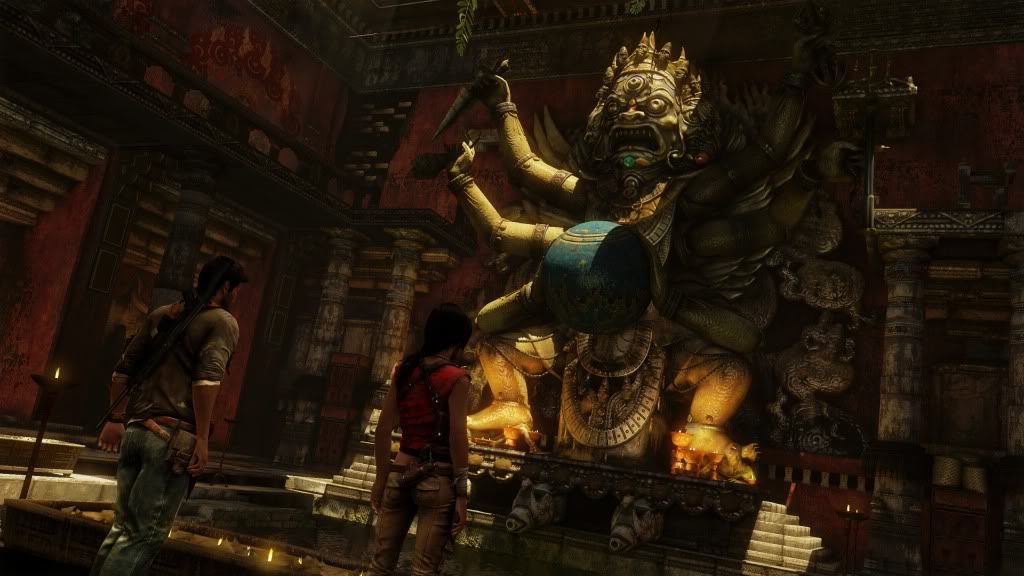
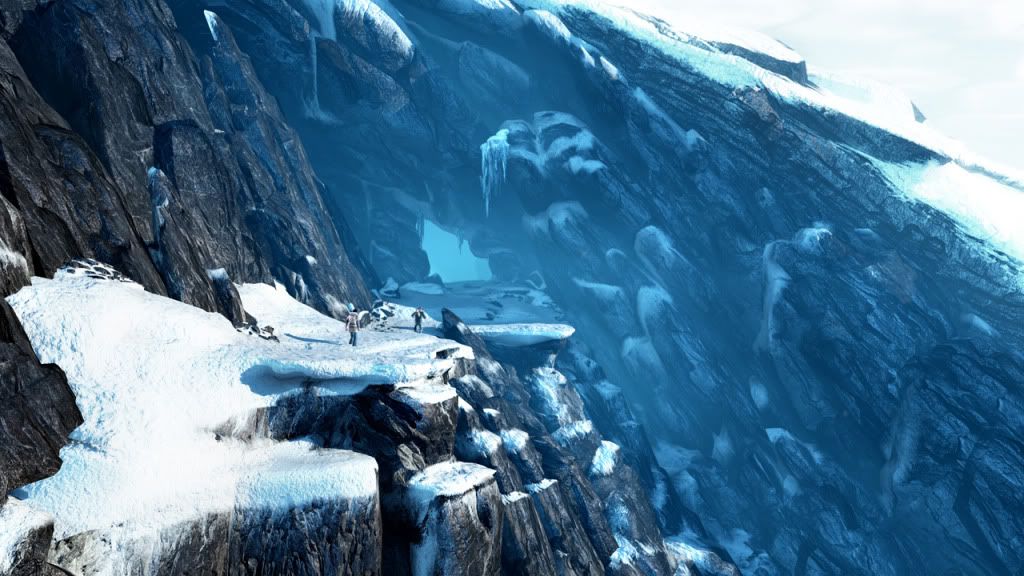
Back in 2007, Uncharted: Drake's Fortune showcased the PlayStation 3's graphical power, two years later Uncharted 2 isn't that much different. There's a bit more detail and particle effects to the environments, and it's still lush with color, which isn't something you see often this generation. What I also really enjoyed was the level variety, unlike the first game, where you spent all game in the jungle... until the very end. This time around you go from the sewers in Istanbul, Burmese jungles, a Nepalese city, the snowy mountains of Tibet and more, which really makes the game's graphical engine shine, instead of just showing the same place.

The graphics in this game are very similar to the first game, but that isn't a bad thing. The environments are lush and vibrant, and the character models are very good. The animation is pretty top notch, and you are slowed by piles of snow or deep water, and the effects, like a wet shirt, are noticeable and a good little touch. The graphics alone won't completely blow you away, but coupled with the storytelling and score, it all comes together for a great package.

Sound
The sound design in Uncharted 2 is pretty fantastic. It's got a great cast that fit's the characters they're portraying, the emotion feels real, and the soundtrack rivals many a Hollywood feature. Put all of that together with the great cinematic look and feel of the game, and you've got an experience more fitting of a TV drama than what you'd expect to see and hear in a video game.

The story is presented via cut scenes which are voiced very well. All of the characters are believable and their voices match. I can’t complain about anything in there, but outside of the cut scenes, enemy exclamations are repetitive. And Nolan North’s voice is becoming more and more apparent to me in other video games….it’s odd.

Final Thoughts
I finally played the first Uncharted right before Uncharted 2 released this past November, which explains why this is a bit late. I loved the first one enough to want to play the second, and I was glad to see that the whole experience was very much improved, from the gameplay, to the graphics, to the score, all better. Sure, not everything is overly improved, but the game is definitely a step above the first, and certainly one of the best releases on PS3 and one of the best games released in the last decade. The online multiplayer adds to the experience once you finish the single player, but it may not be for everyone.

Overall, Uncharted 2 is a great sequel. It has everything the first game had, and a bit more. If you enjoyed the original, then this is simply another adventure that you will get to explore with familiar characters. However, if you didn't like the first, then this one wouldn't change your mind, as I believe it to be very, very similar to its predecessor. Granted, I haven't played the first in a very long time, so ask Jared what you think, but I believe they didn't add much to it, aside from the multiplayer, which has the possibility of hooking players in, assuming you don't already play something like Modern Warfare 2...

JDW's Score: 9.5/10
Zach's Score: 9/10

Overall Score: 9.3/10

Well this one's a bit delayed, but it wouldn't be the first time we've given out a VFH Seal of Approval a couple months late. Personally, I can't say I've thoroughly enjoyed another PlayStation 3 game this generation as much as Uncharted 2, except for Metal Gear Solid 4. I mean, other exclusives like the first Uncharted, LittleBigPlanet, and others I really enjoyed, but at the same time there would be things in those games I really didn't like. Uncharted 2 really is a near perfect game, and should be experienced!

Sunday, November 15, 2009

Fantastic Mr. Fox review

And the reviews just don't stop this weekend! Regardless, finally, quite possibly my most anticipated film of this season arrived in theaters this weekend (well, most theaters; it opened hear in New York and in Los Angeles, but won't open elsewhere until Thanksgiving), Fantastic Mr. Fox, the latest film from one of my personal favorite directors, Wes Anderson.

But what sets this film apart from Anderson's five previous films? Well, for one, it's his first stop-motion animated film, and it's his first adaptation, being based off the Roald Dahl book of the same name (which I finally got around to reading a few weeks ago, just for the purpose of analyzing the film...). Another thing different about the film, is that it's Anderson's film with a PG rating, and considering all of his prior films were rated R, that's kind of something worth taking note of, but I'll explain later.

The film, like the book, follows Mr. Fox (George Clooney), a sneaky fox who likes to steal from farmers. What's different here though, is that Anderson has personified Mr. Fox, giving him a personality and motivation, which isn't as clear in the book. Here, having given up stealing, he's a husband to Mrs. Fox (Meryl Streep), father to Ash (Jason Schwartzman, and created for the film), and uncle to Kris (Eric Anderson, also created for the film), and is employed as a newspaper writer and wants a better life for his family. But when Mr. Fox finds a new home, across from three dastardly farmers: Boggis, Bunce, and Bean, his old stealing habits kick in, and it may cost him his home, and the respect of his family and friends.

For the most part, the film sticks to the story of the book, albeit a bit indirectly. I'm not going to spoil anything for those that haven't read the book, but those that have read it will probably see how the events of the book are re-imagined with Wes Anderson's unique vision, making the story all his own. In short, it's the story of the book, but just tweaked. I didn't think it detracted from the enjoyment of the film, and if you haven't read the book this won't even be a factor for you, but it just seemed worth noting.

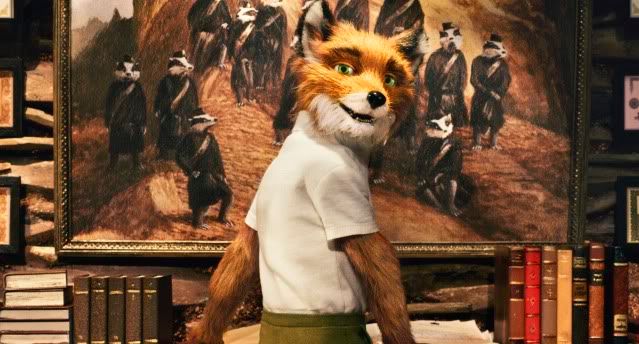
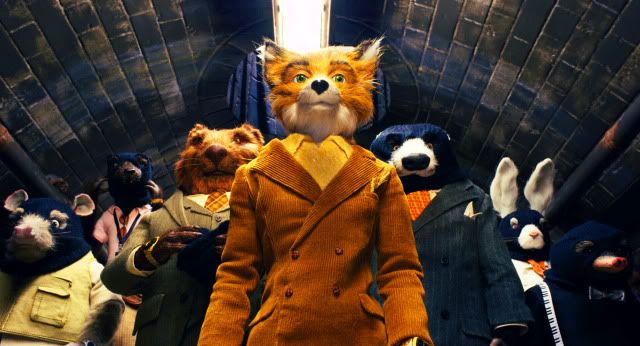
The biggest difference between Fantastic Mr. Fox and Anderson's previous work is obviously the change from live-action to stop-motion animation. I can't speak for everyone, but I know that before I saw the film, I questioned if Wes Anderson's signature filming style could be translated into a stop-motion film starring animal puppets. I can now say, after watching the film, that yes, there's no denying that this is indeed an Anderson film; from the flat shots and use of symmetry, there's no denying whose film your watching when you see this. And it's not even a limitation on the animation, which looks great (especially on the human characters) and flows well. It's unlike any stop-motion film I've seen before.

Even in the writing, the way characters talk and act is just that signature look, and while you may not actually see Anderson regulars like Bill Murray, Jason Schwartzman, and Owen Wilson, you will hear them, and think that also helped in retaining the feeling of his films. But, the non-Anderson regulars perform just as well. George Clooney and Meryl Streep have a really nice voice chemistry together, and they just seem so fitting for their characters; it's the type of film you can watch without thinking "oh hey, that's whatshisname!" throughout the whole thing because they just sound so natural. I really enjoyed Willem Dafoe as the oddly-Creol Rat, Michael Gambon as Bean, and Jarvis Cocker (who many may know as the former lead singer of Britpop band, Pulp) who has a small singer role as Petey, who looks like a caricature of himself. And to further the natural sounding voices, it's interesting to know that none of the voice work was actually recorded in a studio, instead Anderson opted to record in outside locations and such, and it really makes everything sound more believable despite seeing animal puppets on-screen.

Now that I've covered Anderson's hurdles of adapting, and moving to stop-motion, it's time to look at the most peculiar hurdle of them all, the PG rating. I'm always amazed when directors like Robert Rodriguez and Stephen Spielberg can go between gruesome rated R films and family friendly PG films so frequently without having any sort of hiccups, so it's interesting to see how Anderson went from five rated R films, to his first PG film, other than the fact that he adapted a children's book, in an animated format. There's a lot of peculiar dialog that you wouldn't expect from a film of this nature, like speaking of death, existentialism, alcoholism, and even the inclusion of characters that smoke (which is actually pretty much unseen in most children's media nowadays). Or for instance the word 'cuss' is used a lot in terms that would otherwise be wildly explicit, such as 'cluster-cuss,' 'are you cussing with me,' and 'what the cuss?' I'm sure you can get the gist of what they're trying to say there, and while I don't care, I'm sure many parents may not like the inclusion in what's targeted as a film for children.

The way I see it, Anderson made this film just like he would any other, but obviously changed the dialog and gave the film some wackiness thanks to the medium, so that it could be accessible to more people than just his usual fans. I think the way a lot of these more mature references are presented is so that adult viewers will get it, and the rest will just fly over kids' heads. When I saw the film, it was a primarily adult crowd, so I can't exactly say how kids will react, but everyone else seemed to be having a great time; I know I was having one.

Overall, I'd have to say, pardon me, but this film was FANTASTIC. It's an interesting case of a director known for sticking to the same style finally coming out of his comfort zone and creating something that feels familiar and yet is unlike anything done before. Fantastic Mr. Fox is certainly a new benchmark for Wes Anderson, having had mixed reviews on his last few films (though I liked them), and is certainly his most accessible film to date. When this releases nationwide next week, do yourself a favor and see this film, fan of Wes Anderson or not.

Overall Score: 9.6/10

Okay, don't give me that look, it may seem a bit biased, being that Wes Anderson is one of my favorite directors, but this is also my site. I will say, despite really liking all of Anderson's films, this film may actually be my new favorite of his. I'm not sure if it's the animation, or the cast, or the great soundtrack, but something about this film is just far more striking than anything else that Anderson has done before. What I really admire is just how well the movie was made despite being his first stop-motion feature (Life Aquatic had some stop-motion, but those segments were done by Henry Selick), while still retaining his signature film style. And despite being an adaptation, Anderson found a way to make it feel like it was all his own, while still being reasonably faithful to Roald Dahl's original book. Fantastic!

Wednesday, October 7, 2009

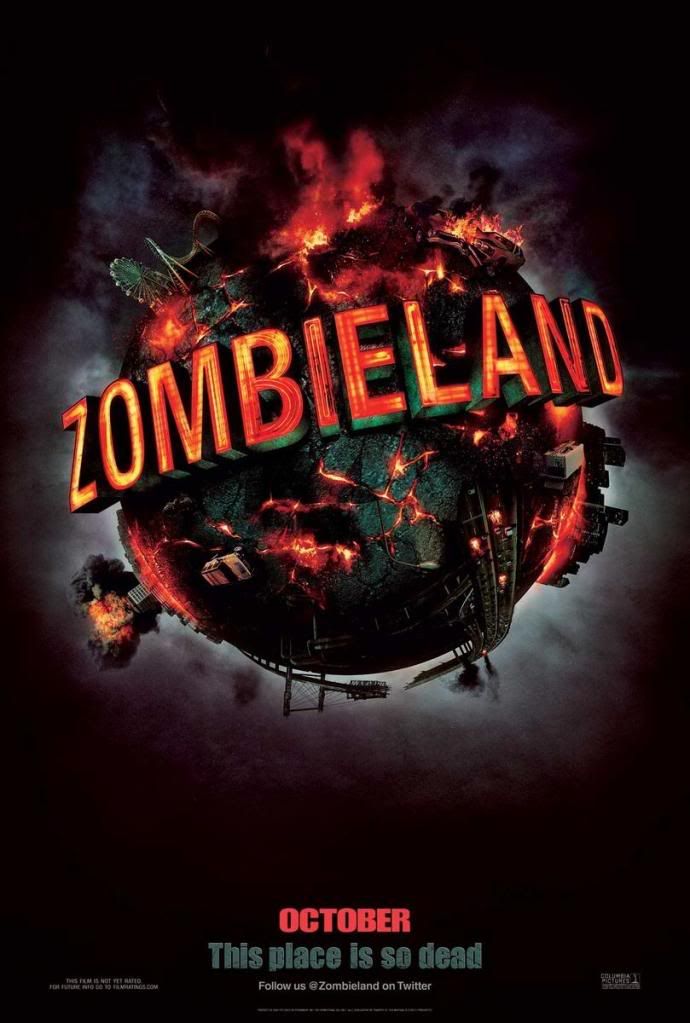
Zombieland Review

Do you like zombies?! Do you like violence, gore, and comedy?! Do you like amusement parks?! If so, then Zombieland is the movie for you! If not... then maybe you should skip over this one...

Zombieland takes place on a post-apocalyptic Earth, infected with, what else? Zombies of course! The film follows two characters, the first is Columbus (Jesse Eisenberg, who amusingly was last seen in the unrelated film, Adventureland), a paranoid teenager, whose had few friends, and has too many phobias to count. He is very organized, and has a plethora of rules that he uses to kill zombies. The second is Tallahassee (Woody Harrelson), you can consider him the badass of the film. He has a massive hatred of zombies, and an undying love for Twinkies. He often puts himself in life/death situations solely to get his hands on the almighty Hostess treat. As far as zombie killing goes, he tends finds new, creative ways to slay various zombies, and enjoys every last minute of it.

Tallahassee refuses to use anyone's real name because he feels that by doing so, they grow closer to each other and you don't want to have feelings (of any kind) for another in Zombieland. Eventually Columbus and Tallahassee join forces with two girls: Wichita and Little Rock. These two girls have a tendency of finding survivors, and stealing their guns, ammunition, vehicle, and whatever else they may have with them. They do whatever it takes to survive and have one simple rule: "Only trust each other."

The thing that really surprised me about this film is that nearly every scene in the film kept me on the edge of my seat. I went in expected a good comedy film, with some zombies added to the mix. Boy was I wrong. I find it better to describe this movie as a horror film with a ton of comic relief. And with horror comes gore, which also surprised me. I myself am not much of a gory guy, and often find myself looking away during a horror film. It was no different with Zombieland. I find myself enjoying a majority of zombie-slaying techniques such as the good old fashion shot to the brain, or a neck breaking. On the other hand, I do NOT enjoy some killing techniques such as: smashing a zombies head like a watermelon with a big ass hammer. Or how about: cutting off a zombies head with a pair of hedge trimmers. Mind you, that if you DO enjoy such things as those, feel free to see Zombieland because everything stated above, plus many more, are some of those creative and fun zombie deaths that happen so often in this film.

While Zombieland was far more gory and suspenseful than I expected, its comedy aspect was still just as prominent. Even in the goriest of scenes they find a way to throw in some comic relief, and you rarely find yourself with a straight face while watching this film. Tallahassee's quest for a Twinkie will always keep a smile on your face, and so will Columbus' "23 Rules of Zombie-Survival."

Though Zombieland is nearly perfect, there is one little thing that I didn't enjoy: the length. The entire film is only about an hour and a half, and when it ends, it truly leaves you begging for more. If the movie was a mere half an hour longer, I would be satisfied, but alas, it is not. Perhaps this was due to it being Ruben Fleischer's first feature film, but your guess is as good as mine. And while I don't expect to ever see a Zombieland 2, I certainly wouldn't be against it, and I would certainly like to see what other creative ideas could be dished out.

In the end, Zombieland is well worth the money you will spend. Whether it be three dollars, or thirty (if you pay this much at any theater, I'm sorry), you will not regret it. The movie constantly keeps you on the edge of your seat, all the while throwing in as much comic relief as they can. The gore factor of the movie far surpassed what I expected, and if you don't enjoy watching others' guts getting ripped out, do as I do and simply look away, because even then, the movie will not disappoint. Truly, the only thing that I felt the film needed more of was length. The mere hour and a half just ends up leaving you wanting more, and makes the film seem somewhat unfinished.

Overall Score: 9.5/10

I also believe that this film has just received itself a VFH Seal of Approval. Whether your like horror films, comedies, or both, you will certainly enjoy this movie. Words truly cannot express just how much I enjoyed this movie. It is by far the best movie I have seen all year, and seeing a sequel would have me jumping for joy. So how about we put our hands together and give a nice round of applause to Zombieland?

Tuesday, August 25, 2009

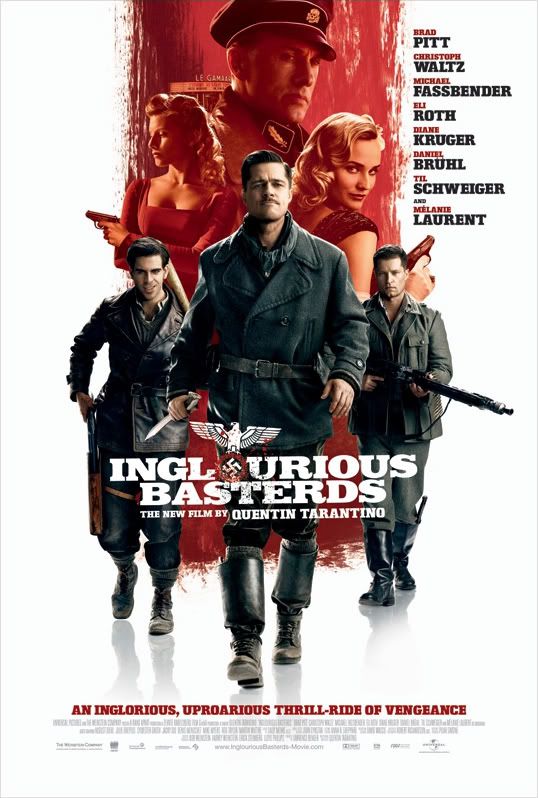
Inglourious Basterds review

After years in development, Quentin Tarantino's self-described masterpiece, Inglourious Basterds, finally arrives in theaters. Despite the negative reviews of his Grindhouse project, Death Proof (2007), and although mainly positive, mixed reviews of Kill Bill (2003/2004), is Tarantino able to deliver a film that truly outshines his previous works? Well, look's like yer 'bout to find out...

Much like his previous films, Pulp Fiction (1994) and Jackie Brown (1997), Inglourious Basterds story is split up into chapters, with each one following a different character (though sometimes this overlaps, much like said films). But unlike Pulp Fiction, Basterds' five chapters are linear, in similar vein to Kill Bill; there's an occasional flashback, but no chapters run out of order.

As for the film it self, the plot centers on two parallel stories which take place in Nazi-occupied France, each about revenge upon the Nazis. The main one, in my opinion at least, is that of Shoshana Dreyfus (Mélanie Laurent) a French-Jewish girl who manages to escape during the murder of her family in 1941. The other is that of Lieutenant Aldo Raine (Brad Pitt) and his unit of Jewish-American soldiers a.k.a. The Basterds, who, in 1944, are looking to kill every Nazi they see, and mark those of which they choose to live. The film basically goes back and forth with each story, with both stories culminating in the fifth and final chapter of the film, which really made the movie for me. If Chapter Five wasn't as great as it was, I don't think I would have enjoyed Inglourious Basterds as much as I did.

But, as is the case with most big Hollywood films these days, the promotional footage for Inglourious Basterds differs somewhat from the final film. It's mainly due to Tarantino's signature filming style, by having chapters from different perspectives; but despite Brad Pitt being the focus of everything, there's a good... 2/3 of the film I'd say that he's not even in. It didn't make me not like film, as I personally avoided trailers and clips until after I saw the film, but I'm sure those of you looking for a Pitt-centric film may be disappointed.

However, for me, the fact that it wasn't all about Brad Pitt's character of Aldo Raine, as amusing as he was, made the film that much more enjoyable, for myself at least. The standout cast member by far was Christoph Waltz as the sinister yet awkwardly amusing Hans Landa, a.k.a. "The Jew Hunter", his stern demeanor clashes quite well the rest of the cast, specifically Brad Pitt's hillbilly portrayal, and Mélanie Laurent's seemingly innocent but full of hate character of Shoshana. The Basterds gang itself has a couple hits and misses, I really enjoyed seeing Til Schweiger as Hugo Stiglitz, a Nazi murdering madman. Though, Eli Roth, who seemed to get more promotional attention than deserved, didn't really convince me with his character's nickname of "The Bear Jew".

Rounding out the cast were the rest of the Basterds gang, none of which were ever too import to remember their names (which honestly made me wonder why they get the title of the film), Diane Kruger as a German actress who double-crossed her homeland, Michael Fassbender as a British spy, and some Tarantino regulars who have bit parts (some you won't even see, I'll leave it at that). Weirdest casting by far though, is Mike Myers as a British General. Much like Tyler Perry's inclusion in Star Trek, when I saw him on screen it was like, "What the hell is he doing here?", and I'm not only one, as the audience seemed to react the same way both (yes, both) times I saw the film.

What really surprised me about the film was just how well Tarantino's signature "cool" style translated from his usually modern settings, to World War II-era Nazi France. And it wasn't just in the way the the movie was filmed, or the chapter divides with different points of view, or even the more than stellar soundtrack (both modern and fitting of the period), but the dialog and character interaction. Despite most of the film actually being spoken in German and French, the way Tarantino handles his characters and dialogue is like no other, and about twenty minutes into the film, you'll know exactly what you've gotten into... judging that you've actually seen his previous work.

Overall, I'd like to think that Inglourious Basterds is right up there in the ranks with Tarantino's arguably best film, Pulp Fiction. At first glance, it doesn't seem like something he would do, but in motion, as a whole, it seems like it's the film that he was meant to make from the beginning, but instead he just waited for the right people and right time to release the film. And I must say, as a fan of his film, it was pretty damn worth. In fact, this is the film I actually wanted to watch twice before reviewing it, not because I couldn't understand it, but because it was just that good.

Overall Score: 9.5/10

I'll be honest, I really debated whether or not Inglourious Basterds really deserved the Seal of Approval. It's an award I personally like to save to under the radar media that is above and beyond stellar, and when it comes to a Tarantino film, it's not really "under the radar"... it's quite above it actually. But upon two viewing of the film within a twenty-four hour period it hit me, the more I thought about the film, the more I realized just how much I really enjoyed it. And if that doesn't matter, I don't know what does. If you can handle the gore/language, or just want to see something truly different, you have to see this movie.

Monday, July 13, 2009

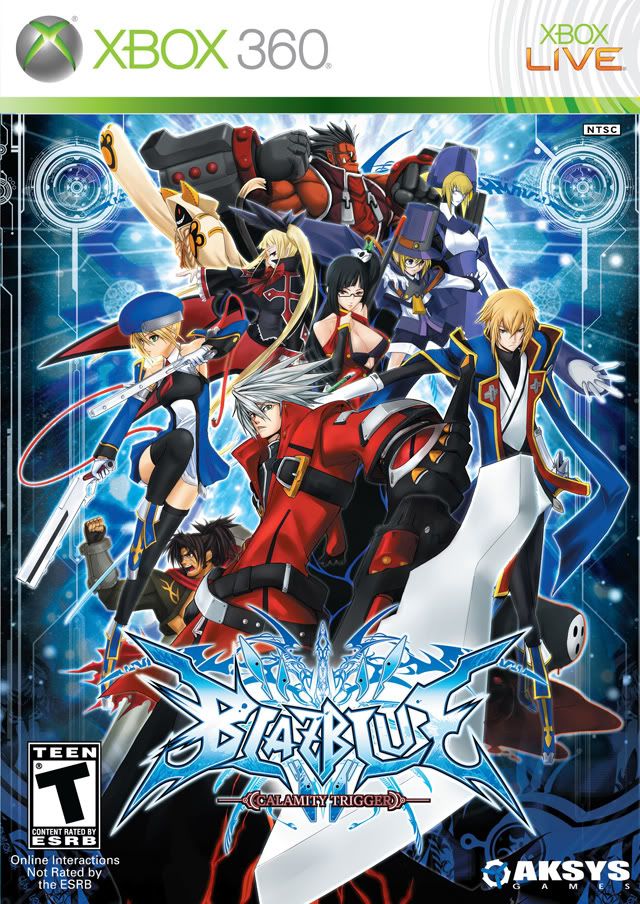
BlazBlue: Calamity Trigger Review

BlazBlue: Calamity Trigger is the best fighter on the Xbox 360. Okay, so that's not really a claim I can honestly make considering I haven't gone in depth with many of them, and the selection is quite varied. Hell, even personal taste comes into play. But it did get your attention didn't it?

None the less, BlazBlue: Calamity Trigger is Arc System Works' first foray in the fight genre for next-gen consoles, and should be considered as the spiritual successor to the popular Guilty Gear series of fighting games.

Story
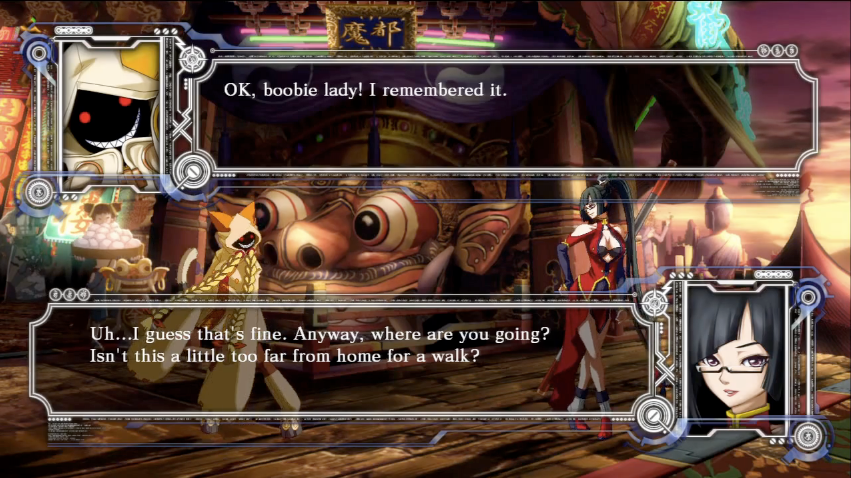
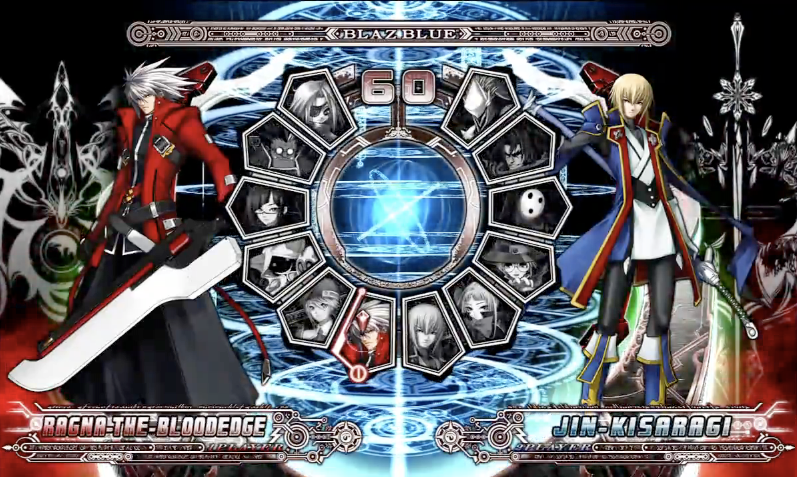
If you're like me, you expect a very sparse storyline with your fighters. Yet, quite to my surprise, with BlazBlue that is just not the case. All 12 characters have very interesting stories to be told through their individual story campaigns. The setting of Kagutsuchi is an intriguing one, and the BlazBlue world is very fleshed out as whole. One problem though. The story mode is played out through a series of character portraits accompanied by text. Those familiar with any older RPGs should know what I'm talking about. It's a little slowly paced, and for those of us without HDTVs, the letters are a bit too small.

Through each characters stories, you have the ability to make choices and see a different part of the story. There are a few branching paths for each character, and all of the ones I've played so far are very interesting. Yet, no matter how interesting they are, it's a bit of a pain to have to go through each multiple times to see the persons entire story. Though, be forewarned, despite all of the flaws with the games storytelling method, I think the story is interesting enough to motivate you to play around the minor quirks. I definitely recommend looking into the story with this one, don't ignore it like you may with other fighters. If nothing else, think of it as a bonus aside from all the standard modes.

Gameplay
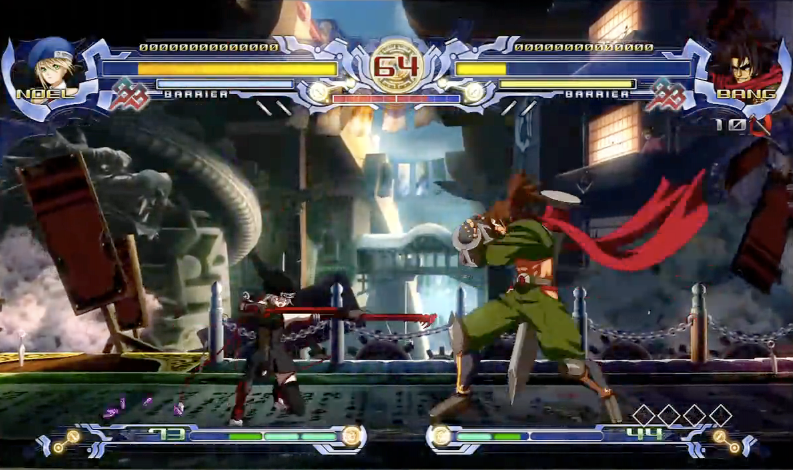
Despite the story elements, BlazBlue is first and foremost a 2D fighter. As a spiritual successor to Guilty Gear, a lot of people will know exactly what to expect. Yet for the rest of you, let me explain a bit. BlazBlue is a single planed, extremely fast paced, 2D fighter. You have your super moves, one hit finishers, and much much more. But before I get to all that, I'd like to touch upon perhaps the biggest innovation in BlazBlue. The Drive button.

The drive button is essentially the special button (Think Super Smash Bros.). One press and you're doing a character specific special move. This is touted as “a easy way to do something cool”, and not only is that true, but the one button special adds even more intensity to the already mind blowing intense battles. Being able to fly across the screen, or control the wind, or even shoot swords with just the press of a button really changes things. It both makes the game more accessible to newbies, and adds depth for veterans. If you're new you start off being able to do at least 1 special. If you have experience, you have a quickly accessible move that has more flexibility and freedom then it would if you had to input a button sequence.

But besides the drive attacks, BlazBlue stays fairly close to Guilty Gear. There are Distortion attacks, which are basically super attacks. They take up various amounts of your heat bar (which I will get to later), require a button sequence to perform, and do large amounts of damage.

You also have the option of doing one button air recoveries, which stop you from being helpless while airborne, barrier defense, which depletes your barrier meter yet completely blocks damage, barrier bursts, which push your opponent from you and can break combos, yet deplete your entire barrier meter, lowering your defense. You also have what is referred to as the Guard Libra. This is a meter in the middle that moves to the side while you defend. If it hits your side, you lose your barrier, and are stunned. Another feature to keep you and your opponents active is the penalty you get when you don't attack for a certain amount of time. The opponents damage will do a bit more.

To keep you from spamming these specials, you have your heat bar. The heat bar depletes with special actions (as mentioned above) and is replenished by attacking your opponent, or gradually if your hp is under 20%. Speaking of under 20%. If it's the last round of the game in your favor, and your opponent has under 20% left, you are able to use your Astral Finish. This is a flashy one hit move, and you really wont see many of these, but they're still worth mentioning.

OK, now I haven't even scratched the tip of the iceberg here, and I bet it already sounds overwhelming. But don't worry, it all comes naturally after a few rounds. If it doesn't you can hone your skills in training, or do a few playthroughs of Arcade Mode, just to get the hang of things. Maybe pop in story mode on those slow days, switch it up with a score attack every now and then. The game is packed with different modes. But the most important one of all, is the Network mode. [See below]

Finally in the gameplay department, I'd like to talk about that extremely comprehensive training mode. You can pretty much toggle everything on and off. Display command, regenerating health, damage, set heath at certain points, record actions for the computer, play against AI, set repeated commands to the CPU, toggle special character power-ups to last forever, all of it. It's all you could ask for, and more.

Online
You can play online with your friends, join 6 player lobbies in player matches, battle it out in ranked matches to move up in the rankings, or just go around and spectate matches. You gain experience based on performance in fights, and level up/rank up accordingly. You won't unlock anything new by leveling up, but it is nice to be able to quickly tell a players experience with a glance.

Your records are kept on a very easy to access D-Card. You can look at yours, or your opponents at just about any time in the lobbies. It keeps track of rank, your main character, your secondary, your wins and losses in ranked and player, and a few other stats like that. It's a nice little thing to have so you know what to expect from the other players.

Another big part of the online is the ability to save and upload your match replays. You can save any online match's replay, or go to the leader board and pick up some matches, then watch them in the replay theater. You can go frame by frame, slow, fast, you name it. It's a very nice, very welcomed feature, and coupled with the extremely comprehensive (extremely comprehensive, it must be said twice) training mode, it makes for both good entertainment, and a good way to improve your game.

Graphics
The game is beautiful. Downright gorgeous. The sprites are big and clean, the backgrounds are just plain breathtaking on certain stages, and the character designs are all crazy, and very interesting. All the characters personalities show through their art, and even can be seen in their battle animations. Which reminds me, the animations, they're amazing too. I simply cannot express to you how gorgeous the entire game is. Even the menus are a delight. Something I've neglected to mention thus far, is the gallery. By accomplishing certain tasks, you unlock art and videos, and it's all stunning. This is high resolution, breathtaking stuff. All of it is worth checking out, and it may in fact turn out to be your driving force for playing the game. It's one of mine right now.

To finish off the graphics section, I thought I would tell you, I have always been a big fan of 2D games. It's what I grew up on. So if 3D is more your thing, then you may be a little put off at first, but I beg you to not expect realism, and to love the anime inspired, beautiful artwork.

Sound
Sound is another area where BlazBlue excels. The soundtrack which comes with the Limited Edition is more than worthy of being a regular in my cars CD player, or getting a playthrough on iTunes every once in a while. It's mostly rock, and it does an amazing job of giving the furiously fast and action packed battles a little more umph.

The voice acting is decent overall, and the option to choose the Japanese tracks is very welcomed. On top of that, something that really struck me as impressive was the ability to control settings for each individual character. Hate so and so's voice? Well you can turn it off! This is something I would have loved to have in many, many other games. I'm glad to see it show up here.

Limited Edition Material
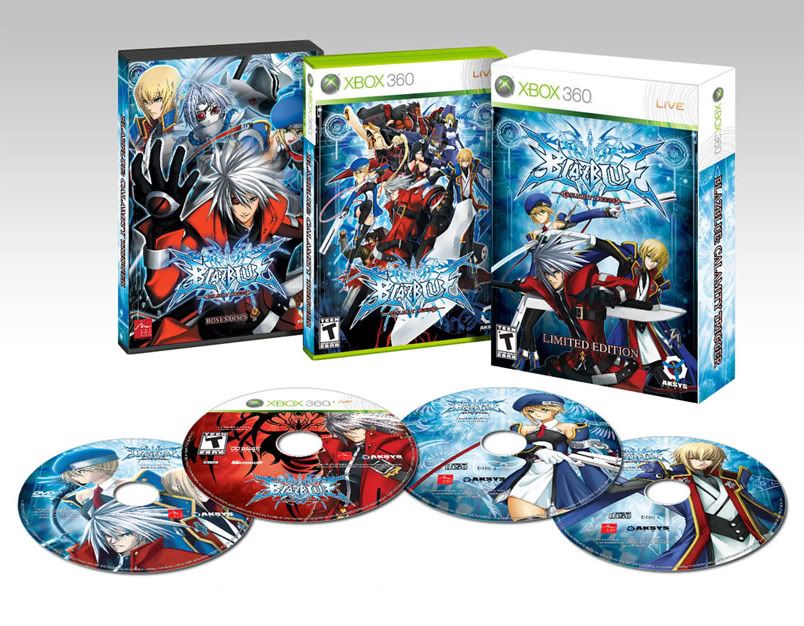
This portion is over the Limited Edition material, so if you're not into looking for a LE copy, then go ahead and skip this. Basically, this version of BlazBlue comes in a large cardboard box with two DVD cases. One with BlazBlue (and its full color instruction booklet), and another with 2 CDs and a DVD (on PS3 it's a Blu-ray). The case itself has a nice cover, and the CDs and DVD all have nice art on them. The CDs have, as far as I can tell, all of the game's soundtrack, and a few remixes. The DVD shows combos and strategies for each character, as well as some exhibition matches. It's a great way to introduce you to more advanced techniques. I'd really recommend finding the LE version of the game, especially since it comes at the same price. The CDs are kickass, and the DVD is a great help.

Overall
BlazBlue: Calamity Trigger is as of now, my favorite Xbox 360 game. Before now I was never serious in any fighters, but BlazBlue is about to change that. The game is just so full of content, depth, and personality. The game is a prime example of 2D fighters at their best, and SHOULD NOT be missed by any fighting game fans (whether you own a 360 or PS3).

Overall Score: 9.5/10

A Seal of Approval. You saw this coming didn't you? I'm awarding BlazBlue the second VFH Seal of Approval to go to a video game. Believe me, it's well deserved. The sheer amount of content itself is astounding. Wrapping all that up in the best 2D fighting system around, sprinkled with lovable characters, and you have a recipe for win.

Thursday, July 9, 2009

Moon review

Duncan Jones makes his feature film directorial debut with Sam Rockwell in the lead, in a science fiction film like no other. Does Moon stand-out amongst other science fiction greats, or does is need to come back down to Earth? (Yes, puns are great ways to open reviews...)

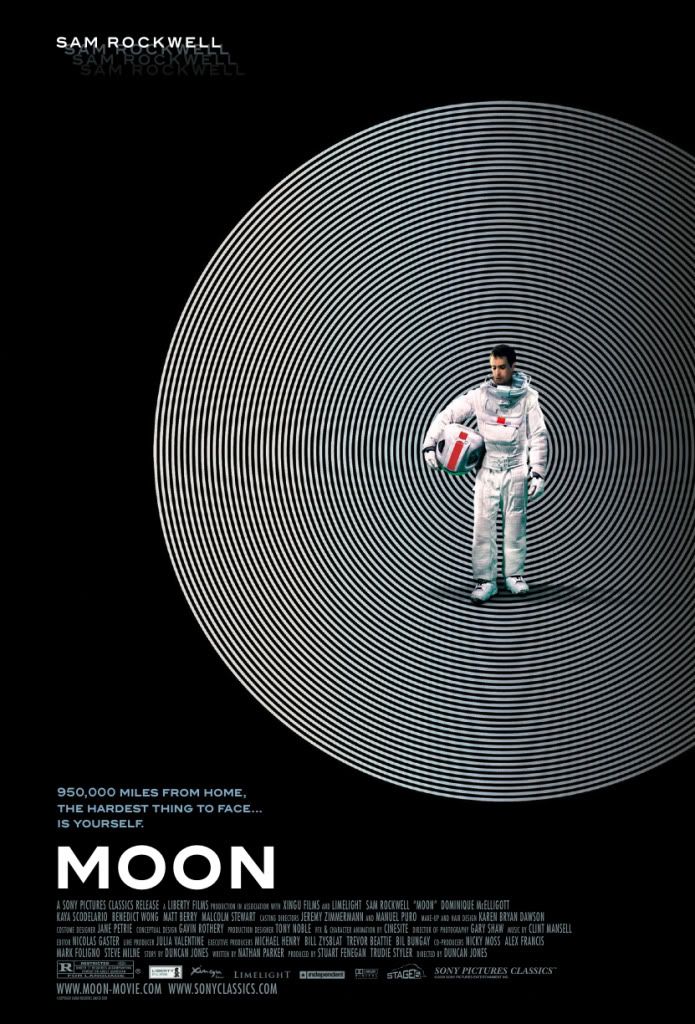
What will probably come to many viewers minds before even seeing this film is just who is Duncan Jones? To get this out of the way, he is the son of famous singer (and actor, I suppose), David Bowie. It's not something that effects the movie, but if you're wondering how some random guy was able to get a film like this out... yeah. Honestly, after watching Moon, I don't think anyone needs to label Duncan Jones as Bowie's son, "director of Moon" will probably work just fine. Personally, what caught my attention for the movie was the brilliant, retro-chic poster (you can click that one up there for a better view) for the film, which then led me to see the even more brilliant trailer.

As for the film itself, Moon centers around commercial astronaut, Sam Bell (Sam Rockwell), who has been alone in Lunar Industries' Sarang Moonbase for nearly three years, monitoring the mining of Helium-3, Earth's primary source of energy. Just a note, the movie never actually gives a specific date as to when the movie takes place, but perhaps it was to protect the plot (I can't much more there). Though he is the sole human on the Moon, Sam is monitored by a computer system, Gerty (voiced by Kevin Spacey); but before you get ahead of yourself, the relationship between Sam and Gerty is nothing like Dave and HAL in 2001: A Space Odyssey.

But all is not well; while prepping for his last few weeks on the base, Sam starts to believe he's losing his mind from being there too long. On a regular maintenance drive, Sam accidentally crashes after seeing what he believes to be another person, however, he awakens soon after back at the base, as if the crash never happened. On another check outside the base, Sam stumbles upon a crashed lunar rover, and the man inside is himself. As VFH standard, I cannot give away anymore for reason of spoilers, but the film involves Sam interacting with his duplicate, in a story that delves into a conflict of man vs. himself in more ways than you could imagine.

To say the least about the story, since it's really hard to delve into without spoiling, I really had no idea where it was going to go; and that's a good thing in my opinion. Of course, I did have some idea, having already watched the trailer about fifty times, and reading a synopsis or two, but the film has plenty of suspense and mystery, and I think those traits always have a place in science fiction.

The main thing that makes Moon very unique is that the cast really only consists of Sam Rockwell. Sure, Moon is not the first film t feature one actor playing a duplicate or twin of themselves, but how many films only have one cast member? To be fair, there are others, such as Sam's wife and daughter which he only interacts with via pre-recorded messages, and there's Gerty, but the interactions between the characters of Sam is a truly unique thing to witness. In fact, the last film I saw with Sam Rockwell in it was 2005's The Hitchhiker's Guide to the Galaxy, so I can't really judge the guy on his experience, but if Moon is anything to go by, he can actually pull off this serious (though sometimes comedic) role. If I have any gripes, it's probably due to the unnecessary choice language by Sam's character; I'm all up for cursing, but sometimes twelve f-words in one sentence aren't needed to express your emotions in a film.

In addition to the casting and setting, what really made the film for me was the soundtrack. While some tracks repeated throughout the film, Clint Mansell's score for the film is epic, and makes the desolation of the Moon even more dramatic, and the engaging scenes so much more thrilling. Really, I don't think Moon would be half as memorable and/or compelling without the great soundtrack.

Overall, what I really enjoyed about Moon over other sci-fi films was the conflict of man vs. himself, instead of the typical man vs. machine or man vs. extra terrestrial; it's a science fiction film that proves you don't need fancy special effects or complex alien races just to make a unique, thought provoking experience, and I think that's what made me really enjoy it. If you can manage to find Moon playing in your area (as it's currently on very limited release), please do yourself a favor and check this out if not once, a few times.

Overall Score: 9.8/10

Had Moon been a famous director's fifth theatrical film, I probably wouldn't give it as much praise; not that it's a bad film (far from it), but when a directorial debut is this compelling, it's truly special. So for the fact that this is Duncan Jones' first feature length film, he definitely deserves some high recognition; that or a VFH Seal of Approval. What's even more fascinating is that Jones was able to make a truly unique and special science fiction experience on a lowly $5 million budget (and yes, that's actually low by today's standards). Perhaps he adjusted the story to the budget by having only one cast member, but regardless, Moon is a movie you'll probably want to watch a few times to fully understand it, and in the end, its thought provoking story is really what makes it shine.

For more on Moon, see Moon-Movie.com

Friday, June 5, 2009

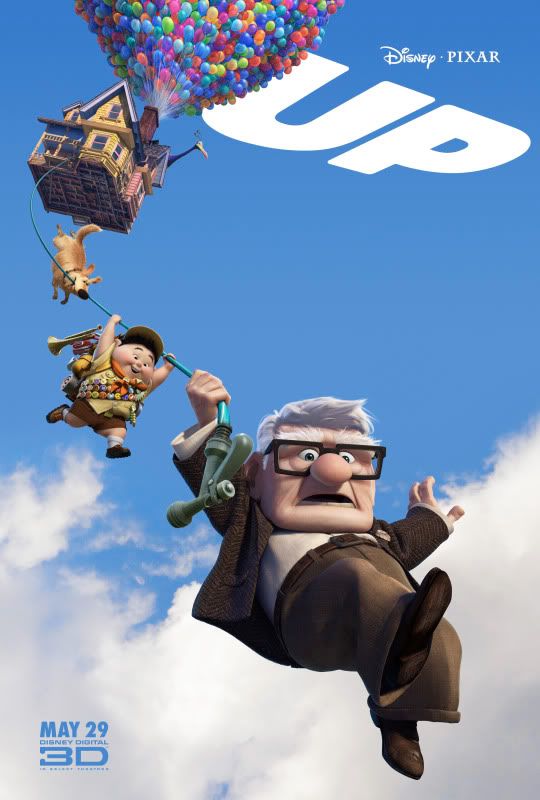
UP review

After seeing WALL-E last year in the theater (and then again on Blu-ray), I thought Pixar's work, and computer animation in general, couldn't get any better than that. Today, Pixar proved me very wrong with their latest film, UP, directed by Pete Docter, who previously directed Pixar's Monsters, Inc.

Now while the film is advertised as 3D, the glasses type not the rendered type (which it is, but you get my point), I saw the film in it's flat, glasses-less version. And quite frankly, after watching the film, I don't think it needed the extra effect... But more on that later.

UP centers around Carl Fredricksen, who we see as a child when the film opens. Young Carl is a huge fan of adventurer, Charles Muntz, who explored South America in search of an elusive bird. One day Carl stumbles upon a beat up home, only to find a girl there, Ellie, who is also a fan of Muntz and has a heart for adventure. Soon after is a really touching sequence of Carl and Ellie, with no spoken words, showing the two growing up, getting married, buying the house they met in and growing old together. The sequence also brings about Ellie's death, and for what is label as a "kid's movie", it's all incredibly sad and had I not been in the theater with someone I probably would've cried (no really, I was holding back... don't give me that look!).

After the sad sequence, the film shows Carl in what one would assume is present day. He lives alone, still in the home that he and Ellie bought, even while the world around him has become a development and he is constantly pressured to leave his home. Around this time we meet Russell, a Wilderness Explorer (aka Boy Scout) who is looking to finally earn his "Assisting the Elderly" badge, but Carl has no interest in participating. After an unfortunate event, Carl is forced to leave his home, but not before he lets loose a ton of balloons and lifts his home off the ground... but he's not alone.

The rest of the film centers around Carl and Russel's adventure in South America, and their encounters with "Kevin", the elusive bird sought after by Charles Muntz, and Dug, one of Muntz's highly trained dogs. This is where the film gets really special, because there's a really great chemistry between all of these characters, and there's a definite sense of character development throughout the film.

What was really interesting though was how many "adult" themes there were for what's considered a "kid's" movie. Not to give much away, but there's the overbearing aspect of Carl being unable to bear with his wife's death, and it's brought up that Russel has some abandonment issues, and there's even a scene with blood. But I don't want to give you the wrong idea, this film certainly has its fun, kid friendly parts for most of the film; but I wasn't expecting the film to be as mature and sad as it was at parts.

Visually, the film shows off Pixar's technical prowess once again, surpassing even WALL-E. Not to be a jab at that film though, as stylistically, WALL-E and UP are two different worlds. However, with a film centered around humans, there's a sense of texture and design that you didn't really see with WALL-E's blobby humans. And while the previous film experimented with the use of live-action and some 2D animation, UP sticks strictly to computer animation, and I don't think it should have be any different. What you get is a beautifully rendered, and lusciously colored film unlike anything else, and it further pushes computer animation as an art form rather than just being the "it thing" in animation. As for the 3D release, I was more than pleased without extra glasses, but I can certainly see where it would be used when watching it flat, but as I said, it doesn't need it for that to matter.

Overall, I'm really surprised with how much I liked UP. I went in seeing this, feeling as if nothing Pixar makes could ever be better than WALL-E, and I was proven very wrong. UP continues on what WALL-E did, by bringing more adult themes into what people consider a medium for children, and I really have the commend them for that. To say least, I'm a bit discouraged that their next two films are Toy Story 3 and Cars 2, but if UP is anything to go by, I have the utmost confidence that Pixar and Disney will continue to make spectacular work.

Overall Score: 9.8/10

Yes, this makes Pixar the first folks to get two VFH Seals of Approval (the first being the WALL-E Blu-ray). Now, you can argue that we're Pixar fanboys around these parts, but the fact of the matter is, DreamWorks Animation does not push computer animation as art form, instead relying on toilet humor, well-known voice actors, and 3D gimmicks. UP on the other hand pushes computer animation further into the adult category, just as WALL-E before it, and I feel if Pixar stays on this track they will soon rival Oscar winning films; but every step counts, and UP is that extra step. Call it what you will, but if animation doesn't evolve as an art form, we will be watching Monsters vs. Aliens 5 in 2012, and who wants to do that?

Wednesday, May 13, 2009

This Week in Lost - 5/13/09

It has finally come to this! The fifth season finale of ABC's Lost. Fifteen weeks of time travel, drama, plot twists, and not to mention, cramped fingers from writing these out each week for you readers! Let's get on with the show:

Season 5 Finale: Episodes 16/17 - "The Incident"

JDW says: Wow ... where to start? Being double the length of a typical episode, there's a lot that went on this week to explain, so I'm going to try and keep it short. What you should know, is that this episodes focuses on the ever elusive Jacob, and yes, you actually get to see him throughout the episode. We are once again tossed back and forth between the 1977 Dharma era, as well as the modern day island crashers; but the scenes with Jacob take place at various points of characters' lives, which makes things very interesting. I should probably say it again, very interesting.

Once again, wow. I honestly think that more happened in the first half hour of this episode, than the entire season combined. And it always seems that way to an extent, the season has its dips and dives, but the finale always comes out on top, and up to the last second leaves you begging for more. It was great to finally get answers about that statue, and Jacob, not to mention seeing people we haven't seen for awhile; sure, Kate may still be whining, but this is what we've been waiting for.
JDW's Score: 9.7/10

Zach says: All I can say is wow. If you're like me, and have been wondering the whole season where Lost had gone, and what happened to all of the incredible twists and plot and mystique, well, it has been waiting until the finale. This is by far the best 2 hours of Lost in a very long time. Questions get answered, shit goes down, and of course, a super cliff hanger at the end.

Through all of their differences, the island gang come together and get work done, but does what they do change the future or was it supposed to happen? And what about Locke and the present-time gang? Well, stuff definitely went down with them too; some crazy ass stuff. Let's just say, things may not be as they appear, but of course, we'll have to wait until next season to see what that means ... I can't say too much, but just watch it for yourself. It's pretty much incredible and answers some of the biggest mysteries around, like who Jacob is. We'll let you in on more in our season wrap-up next week.
Zach's Score: 9.9/10

Overall Score: 9.8/10

What's this?! Yes, it happened. Whatever happens, happens, no?

JDW Says: Funny how when things come to an end they just seem to better than they ever were, instead of, you know ... just being good all of the time. That is why we felt "The Incident" deserves the VFH Seal of Approval. Not just because it's great on it's own, but through all the Dharma drama we've had to sit through week after week, the team behind Lost knew how to return the show back to what made it so good to begin with. To echo Jack, "We have to go back!", and we did.

Zach says: The reason the finale is getting the seal is two fold: 1. the episode is incredible in its own right, and 2. it's by far the best episode of the season. This episode isn't about drama or love rhombuses, but goes back to doing what we fell in love with in the first season; intrigue. This finale is what all of us Lost fans have been waiting for, and it makes waiting for the final season so much harder, but so worth it.


And that's it for Season 5. What did everyone else think? Be sure to check out VFH next week, as we'll have a special edition of This Week in Lost that recaps the entire season, and Zach and I will reveal our thoughts for where Season 6 will take us. 2010 can't come sooner!

Missed the episode? Watch it at ABC.com

Thursday, March 26, 2009

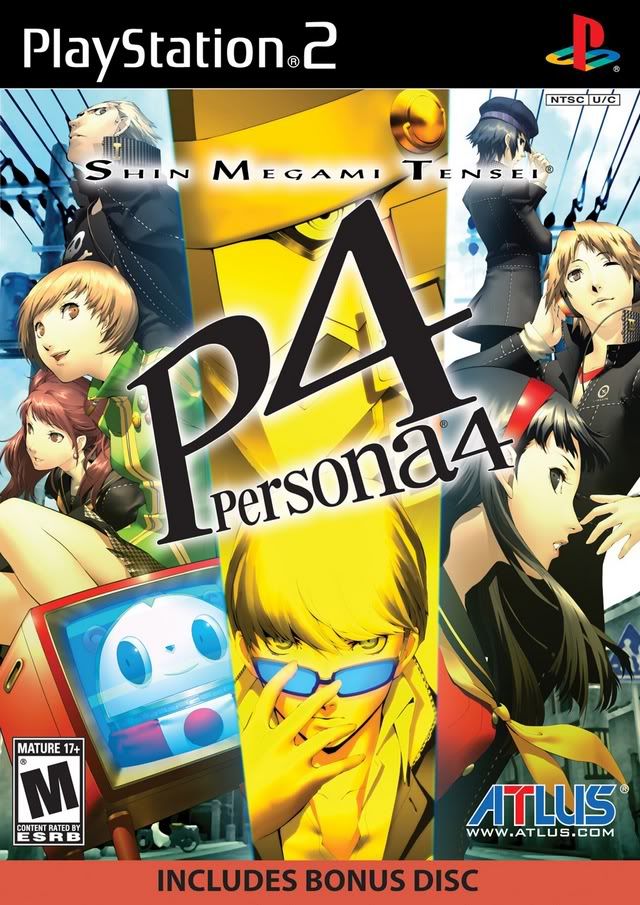
Shin Megami Tensai: Persona 4 review

Shin Megami Tensai: Persona 4, the sequel to 2007's Persona 3 (and its FES re-release), is best described as a RPG/Social Sim. That may scare off a few of you new to the series, understandable. But don't write P4 off as a over clichéd hentai wankfest like a majority of “dating sims," as you'll be missing out on one of the best games to ever grace the PS2.
Story
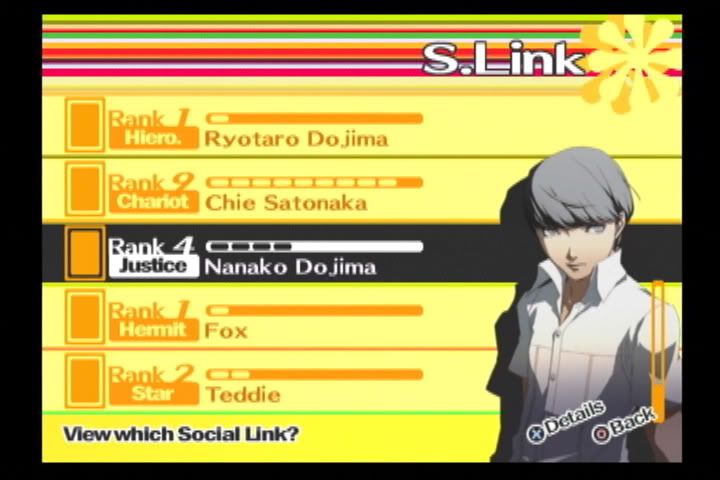
P4 uses a unique, and very effective method to tell its story. There is a main plot which is played out in scenes triggered on certain days, or after certain events. Then there are the Social Links. You can use any free day you have (you have a lot of them) to talk to a friend, and spend the remainder of the day with this person. Every character (or Social Link) has 10 levels. Every few times you get together with a friend, the Social Link will advance, and you will get a cut scene. These normally are about half an hour each if you combine all of the 10 levels. You gather more friends as the game goes on, each with an interesting an unique story. This system works well for character development, breaking up the dungeon runs, and gives you a whole lot of incentive to keep playing. You'll always be in the middle of at least 3 stories, all of which you want to continue. Some of the Social Links are less interesting then others, yes, but as a majority, they're very well written, and very interesting.
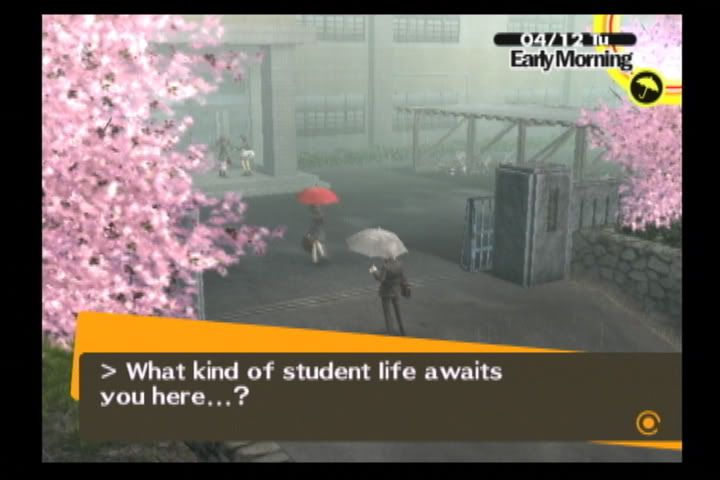
Now that I've explained the Social Link system, and my love for it, I will move on to the main story. I can safely say that P4's storyline, which focuses on a string of strange murders, is by far the best story I've heard in a long time. For perspective, the game I beat prior to Persona 4 was Metal Gear Solid 3. P4 just had phenomenal character, in large part thanks to the Social Link system. Being able to see each characters struggles, thoughts, and life highlighted, watching them grow. That really gets you connected to the characters. You will care about the games inhabitants by the end of the game. On top of that, the murder mystery case had twist after turn, one after another. The story never drags on, never gets boring. The perfect blend of murder mystery and teenage drama, through both the main story, and Social Links, keep things fresh.

Then, adding another layer to an already astounding tale, the game is heavily based on mythology and history of differing origins. The themes are mature, the philosophies are deep, and the insight goes far beyond what most movies, let alone games, approach. I have never been pushed to think so deeply about how I live my life from any medium, game, book, or movie alike. After finishing the game I sat up most of the night, examining my thought process, the lies I force upon myself, the morals I hold, and my very idea of truth. This is what I want to see from stories. Instead of giving people a place to run from life, give us motivation to face it.

I'm not one to cry at any little thing, and I don't get riled up too easily either. Yet still, Persona 4 brought the man tears to the surface... multiple times. I'm not hesitant to say that, considering the brilliance of the games plot. If you don't at least tear up during the game, you are not human. Likewise, you will grow to absolutely loathe the villain. It's sad that so many games fail to make you truly dislike the bad guy, because it makes it oh so satisfying. The way the game reaches out to and connects with all parts of the emotional spectrum is very well done.

The last part of the story I'd like to touch on is the ending. I'm a firm believer that a ending can make or break a game, and P4 blew my expectations out of the goddamn water. Get all 3 endings. You owe it to yourself. They are all amazing, they are all touching, and they are worth the time. The most thought invoking conversations happen in the true ending, so please, don't skip out on it! I cannot say it enough. P4's story was amazing, is amazing, and will continue to be amazing. Graphics and gameplay will in most cases become outdated, but a good story lives on forever.
Gameplay
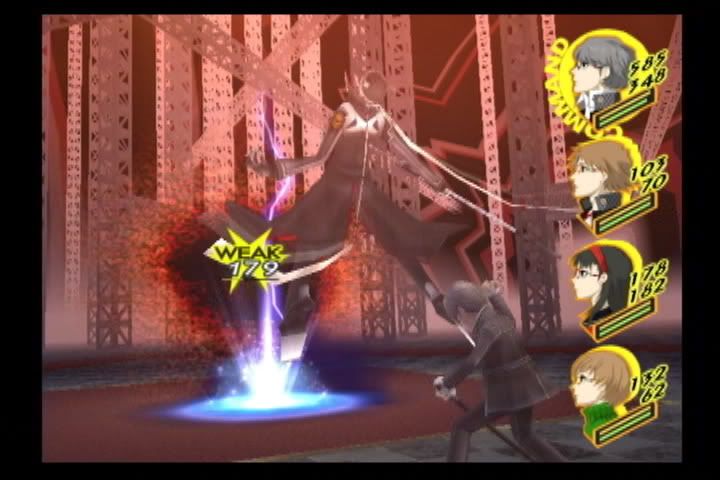
The gameplay in Persona 4 is very diverse for a JRPG. The social aspects in the game are interesting, fun to watch, and are packed with that wonderful story. While the dungeon portions do lead up to most big plot points, they are mostly straight up turn based goodness. The gameplay is most comparable to a mix between Final Fantasy and Pokemon. You have the basic attack, item, and guard options. Then your skills and persona options. Personas are “monsters” you collect and raise, they're where your skills come from. Each persona has a set of skill, weaknesses, and strengths. When you have a persona equipped, you share these attributes. You can raise your persona through training and learn new skills, or you can fuse a persona by mixing two, three, four, five, or six different personas to create a stronger one, which gains experience based on the level of your aforementioned Social Links. This is what connects the social aspect to the dungeon crawling portion of the game, and it works beautifully. There are at least 100 personas to collect, and its pretty damn addicting. I spent quite a bit of my time fusing my persona to try and get the best skill set possible.
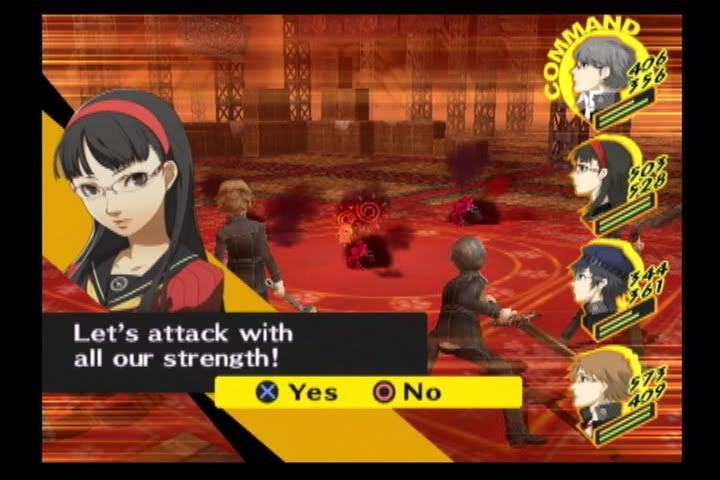
The basic combat system is basic fair, turn based, rock-paper-scissors, type stuff. There are some twists, such as the personas, and the fact that physical skill take away from your own HP. Also noteworthy is the “one more” feature. If you hit a enemy with its weakness you get a second turn, knock down the entire enemy force and you get to do a team attack that normally kills off the enemy forces. I felt that really helped keep the battles fun. Always searching for the weakness, deciding if its worth the risk of trying a lightning attack that could kill the entire enemy force, or backlash and kill half your party.

You get a series of dungeons, each about 10 floors in length, to traverse with your personas and your party. Simple find the exit solutions for most of the dungeons, with a few exceptions. But don't peg this game as easy because of the simplicity of its dungeon design. P4 is the hardest RPG I have ever played. If you want to make it through with minimal grinding to see the story, get ready to swallow your pride and play on easy.


Graphics
The graphics are fairly simple, yet I loved the style of the game. The character models are detailed enough, but nothing spectacular really. The game as a whole had a solid frame-rate, besides one instance in the final battle. That lasts about 4 seconds and really didn't affect the game though. What the game lacks in polygons and lighting effects, it does make up for in style though. The game was bright, and was just pleasant to look at overall. I really enjoyed the character design, and I feel it was far better than Persona 3's.

Worth mentioning is the fact that occasionally, you'll see a small anime cut-scene. These look nice, and help convey the story with a little more detail. I wouldn't call the animation in these cut-scenes the most fluently animated, but they where nice regardless, and if anything, add to the experience rather then subtract from it.
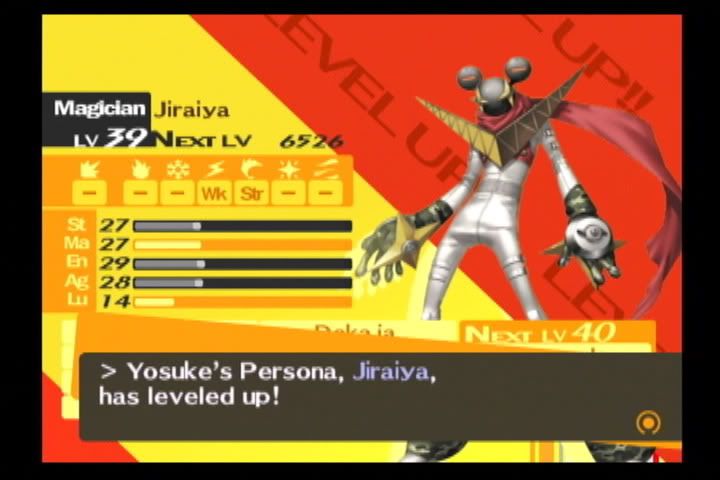
Something I was really impressed with was the design of the personas and shadows. All of the 100 or so personas were modeled, with battle animations, and all were interesting and different; same goes for the enemies. All of them had a fun design that kept the battle scenery from being too repetitive. I just thought it was fun to see the artist's interpretation of mythological figures and creatures. There's a lot of creativity put into the designs for sure.

Basically, the graphics do what they're meant to do, and not much more. They give you characters to assign personalities to, they convey actions and emotions, and they look good. This is the type of game that focuses more on fusing gameplay with story. That's the reason the game works so well on the PS2 this late in the systems lifespan.
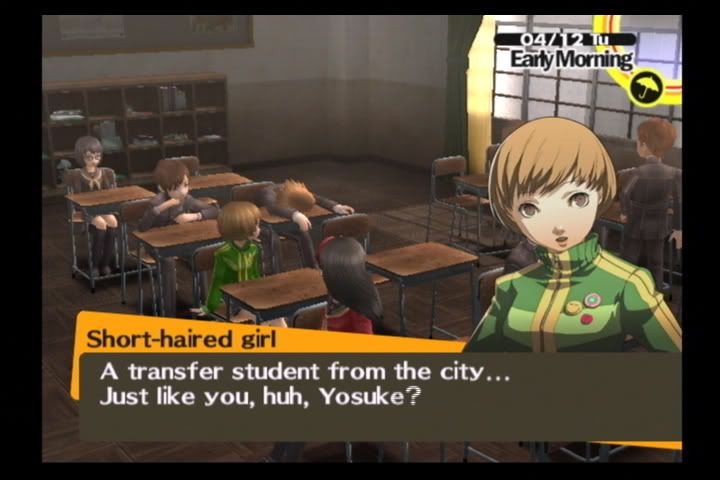
Sound
I loved the P4 soundtrack. Absolutely loved it. The game even comes with a bonus soundtrack CD, and I listen to it quite frequently. The upbeat tunes lend to the bright aesthetics of the game and really just complete the package. If you're not a fan of J-pop or J-rock, then you might be put off a little bit, but for the rest of you, you're in for a treat. This contends with the best of them in my humble opinion. I know music is a little more subject to mixed opinions, but I dare you to not find at least one track in this game you don't end up loving. They did such a wonderful job tying into the emotions being displayed in the game, it's a beautiful thing when when music comes together with the game so well.

On the topic of voice acting, I have good news for you, that I believe fans of P3 will appreciate greatly. It's all pretty damn good (No Fuuka!). All of the voice actors do a brilliant job giving life, and personality to their characters.

Final Thoughts
You may notice that the story portion of this review is a little longer then the rest. I did this one purpose, to convey the simple fact that if story isn't important to you, you're looking at the wrong game here. While the battles will take up a fair portion of time, it's all about the story in Persona 4. You could go over a hour without a single battle in P4. If that bothers you, I still recommend you try it out anyways. Playing this game is a experience I feel every gamer should have. Hell, most of the time I just rushed through the dungeons to get back to the social aspect. Consequently when the game finally ended, I was genuinely sad to see the characters go. After all that time spent building the Social Links with the characters left me attached to them. I'd decided long before the credits rolled to play through again soon.

Be warned, the game is long, it took me about 70 hours to complete. But this is a JRPG we're talking about. That should be expected. Just let me say, that those 70 hours where perhaps the best I've spent playing a video game. I feel like I've learned a lot about the world, myself, and I got to play an awesome game to boot. What more can you ask for?

Overall Score: 10/10
Yes, a 10/10 and the VFH Seal of Approval. Am I saying this game is perfect? Not by any means, no. But I give Persona 4 my highest possible recommendation, not because it will benefit me somehow, or because I have to. But because the game is a prime example of what more games should strive to be, smart, involving, and most of all, fun. I want people to take notice. Anyone who misses out on P4 is missing out on a masterpiece, and that's just a shame. As a reviewer, I'm here to share my experiences with games, and rate my time with them. I'm not saying I'm 100% sure this will be the best game you've ever played. But I sure as hell enjoyed the game, from start to finish it was just amazing. That was my experience, and if you happen to like the game anywhere near as much as I did, I think you'll agree with all that I've said.